
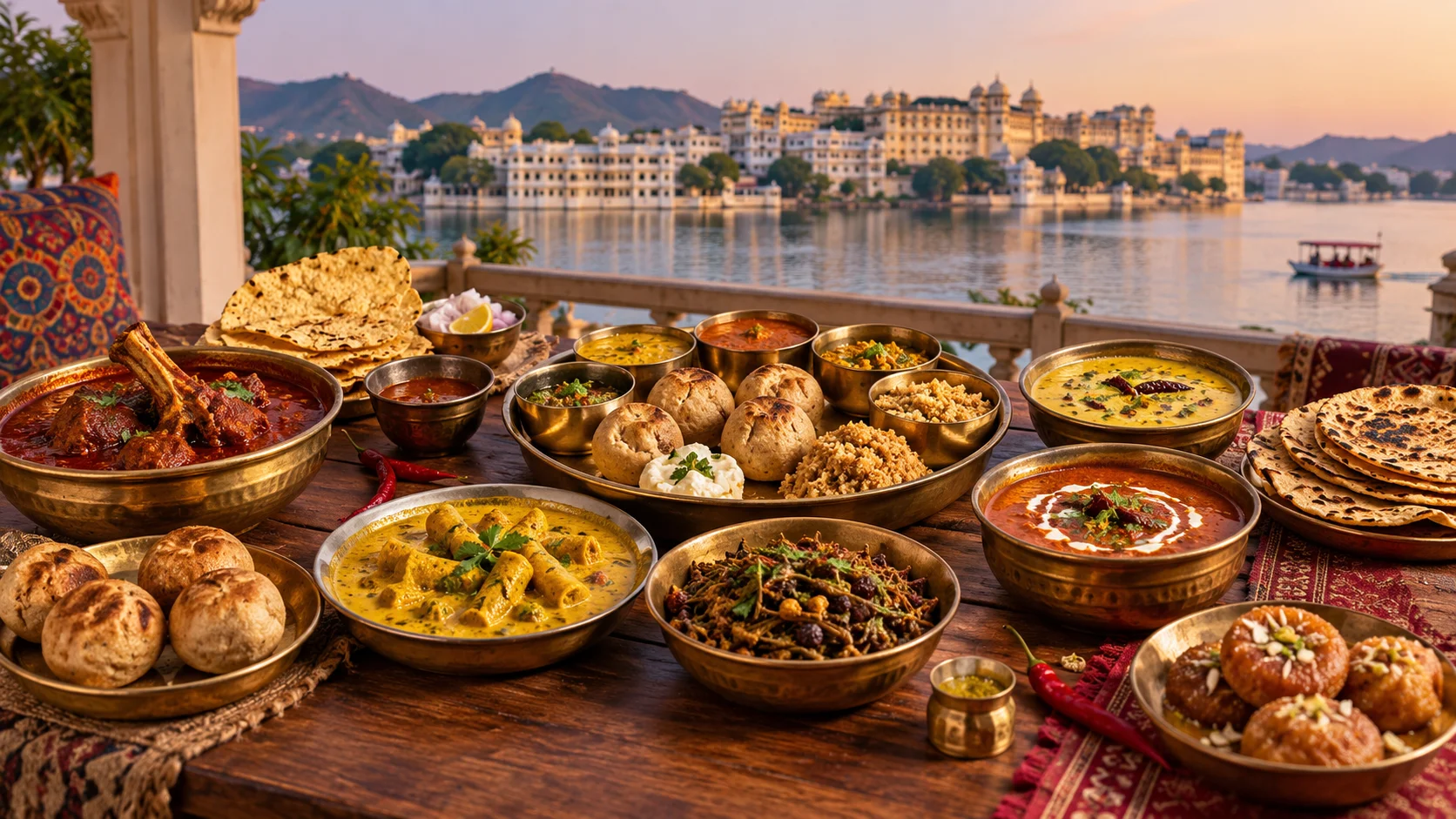
Rajasthani food is one of the most misunderstood cuisines in India. Most travellers eat exactly two dishes — a dal baati at a tourist buffet and something labelled “Rajasthani curry” — and leave thinking the whole cuisine is just ghee and chilli.
It is not. Rajasthani cooking is desert cooking: a set of very clever solutions to a shortage of water, fresh vegetables and refrigeration. Yoghurt replaces water. Gram flour replaces vegetables. Dried berries and beans replace greens. Ghee and chilli preserve. Once you understand that, every dish makes sense.
Udaipur — the old Mewar capital — is the easiest city in the state to eat this food properly, because Mewari kitchens here still cook the regional versions rather than the hotel-buffet versions. Here are the ten dishes worth planning your meals around.
1. Laal Maas
The famous one, and rightly so. Lamb or mutton slow-cooked with Mathania red chillies, garlic and a generous amount of ghee, traditionally a hunting dish from the royal kitchens.
The thing to understand about Laal Maas is that Mathania chillies bring colour and depth more than raw heat. A good one is fiery, yes, but it is also smoky and deeply savoury, with the fat carrying all that chilli flavour. A bad one is just red and painful.
Order it with plain rice or tandoori roti, not naan — you want something that soaks rather than sweetens.
2. Dal Baati Churma
The dish that defines the state. Three components, eaten together:
- Baati — hard wheat balls baked over coals, then split and drowned in ghee
- Panchmel dal — five lentils cooked together, tempered with cumin and asafoetida
- Churma — baati crushed by hand with ghee and jaggery, eaten as the sweet finish
The test of a kitchen is the baati. It should be cooked through with a slightly cracked crust, not doughy in the middle. And it should be properly soaked — a dry baati is a failed baati.
3. Ker Sangri
If you eat one thing that you cannot get outside Rajasthan, make it this. Ker are small dried desert berries, sangri are the long beans of the khejri tree. Both are sun-dried, soaked overnight and cooked with chilli, amchur and plenty of oil.
The result is tangy, chewy, slightly bitter and completely unlike any other Indian vegetable dish. It was born out of scarcity and ended up on royal tables.
4. Gatte ki Sabzi
Gram flour is kneaded with spices, rolled into logs, boiled, sliced into discs and then simmered in a yoghurt-based gravy. In Jodhpuri versions the gravy leans onion-heavy; in Mewar it is often lighter and more yoghurt-forward.
This is the dish that explains Rajasthani cooking best: no vegetables required, no water wasted, and it still tastes rich.
5. Rabodi ki Sabzi
Far less famous, and worth seeking out. Rabodi are sun-dried maize discs, cooked into a spiced yoghurt gravy. Rustic, tangy, and almost impossible to find outside Rajasthani homes and a few serious kitchens.
6. Kadhi Pakoda
Every region of India has a kadhi. The Rajasthani one is thinner, sharper and generally spicier than the Gujarati version, with gram-flour pakodas dropped in. Eaten with steamed rice, it is the lightest thing on this list.
7. Jodhpuri Kabuli Pulao
Basmati rice cooked with dry fruit, gatta, saffron and kewra water. Sweet, aromatic and festive — this is celebration food, not everyday food. If your table is ordering a heavy Laal Maas, this makes an excellent counterweight.
8. Sev Tamatar
Tomatoes cooked into a tangy gravy and finished with crisp gram-flour sev that half dissolves into the sauce. Quick, sharp and a great foil for the ghee-heavy dishes.
9. Moong Dal Halwa
The dessert. Moong dal ground, roasted slowly in ghee until it turns dark and nutty, then finished with milk, sugar and nuts. It takes hours to make properly, which is why kitchens that rush it end up with something pale and grainy.
Order it in winter. It is genuinely one of India’s great desserts.
10. The Rajasthani Thali
If you cannot choose — and honestly, on a short trip you cannot — order the thali. A proper Mewari thali gets you gatta, kadhi, ker sangri, rabodi, a paneer dish, dal, pulao, raita, breads and something sweet, all at once. It is the single most efficient way to understand the cuisine.
There is usually a dal baati thali too, built around the baati with black dal, yellow dal, kadhi, churma, lehsun ki chutney, buttermilk, papad, jaggery and ghee. On Lake Palace Road, the Tour of Mewar section on the Jaajam menu is a good example of how these thalis get put together — the Rajasthani dishes are kept separate from the North Indian and continental sections rather than blended into one generic “Indian” list, which is exactly what you want.
How to order like you know what you are doing
Balance the ghee. Do not order Laal Maas, dal baati and moong dal halwa in one sitting unless you plan to sleep immediately. Pair one heavy dish with one light one — kadhi, sev tamatar or a kachumber salad.
Ask for the heat level. Laal Maas and Mathania preparations are legitimately spicy. Good kitchens will adjust; tourist kitchens will pretend they did.
Eat the breads regionally. Tandoori roti and laccha paratha over naan for Rajasthani gravies. Save the naan for butter chicken.
Do not skip buttermilk. Chaas or salted lassi is not an afterthought here — it is the cooling half of the meal, and it makes the ghee sit far more lightly.
Give the kitchen time. Baati takes time. Laal Maas takes time. Anything that arrives in four minutes was not cooked for you.
Where the food tastes the way it should
The best Rajasthani meals in Udaipur tend to happen in places that treat the cuisine as their own rather than as a novelty item on a multi-cuisine list. Heritage rooftops on Lake Palace Road do this well — you eat Mewari food under an open sky with the City Palace lit up in front of you, which is not a bad way to first meet a cuisine. Jaajam is one such place, opposite Rangnivas Palace, cooking the Mewar section of its menu with hand-ground spices and running a full bar and continental list alongside for the rest of the table.
Whatever you choose: order at least one dish you have never heard of. Ker sangri, rabodi, gatta — these are the ones you will remember long after the butter chicken has blurred into every other butter chicken.
That is the real Rajasthan on a plate.